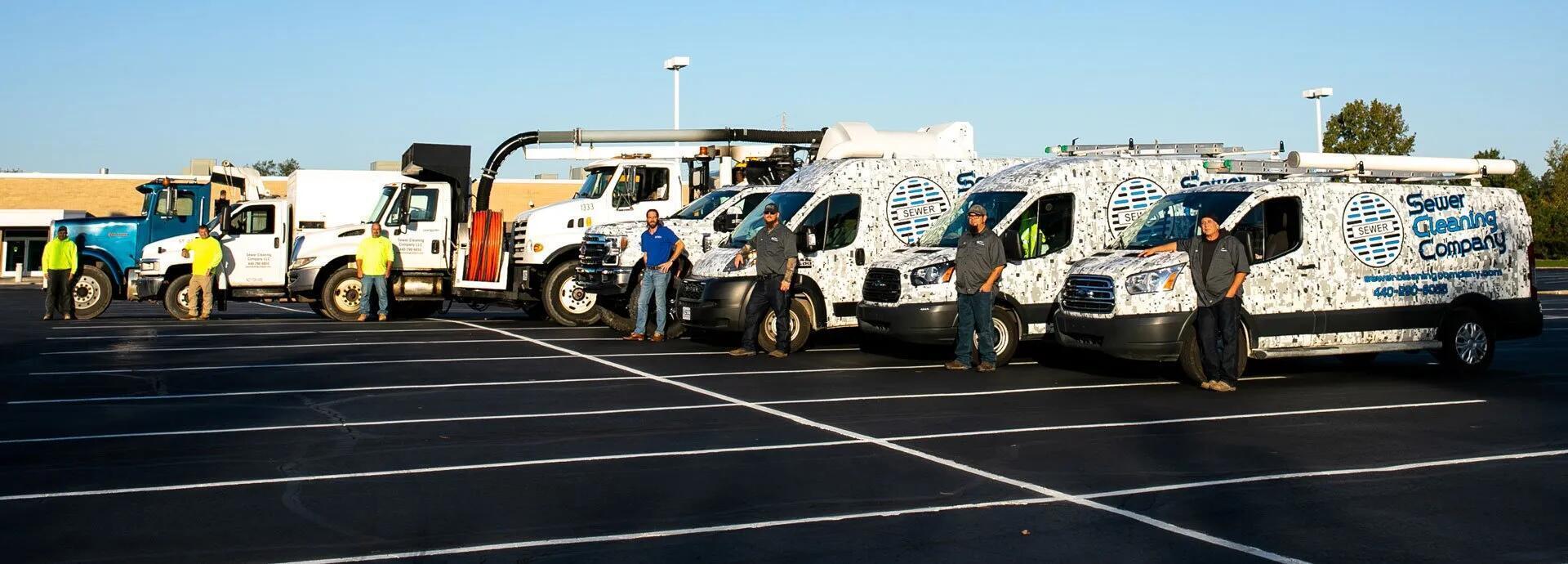
Working out of our E. 55th Street office, on Cleveland's clay laterals and combined sewers.
Worth knowing before you spend anything: the City will come out and inspect its own sewer, and that inspection establishes whether the blockage sits in the City main or in the pipe you own.
Call Cleveland Water Pollution Control at 216-664-2513. In the City's own words, notifying WPC before you contact a licensed and bonded plumber “may save you unnecessary expenses.”
If the problem turns out to be in the main, it is the City's to fix. If it is on your side, that is when you need someone like us — and you will already know which it is instead of paying to find out.
We would rather you make that call first. We lose a few callouts that way. We also stop charging people to diagnose something the City would have diagnosed for free.
When a line backs up and a contractor pulls out a mass of roots, the roots look like the culprit. The City of Cleveland's Urban Forestry Section has published a memo specifically to correct this, and it is blunt about it: “Contrary to popular belief, it is a fact that tree roots do not break water or sewer lines.” The memo cites peer-reviewed arboriculture research for that finding.
The actual sequence runs the other way around:
So the crack comes first and the roots arrive afterward. This matters commercially, because it tells you what actually fixes the problem. As the City puts it, removing the tree will not resolve the issue of cracked and broken pipes. Cutting the roots clears the blockage; it does not repair the defect that let them in, which is why a line that roots once will root again on a predictable schedule until the pipe itself is dealt with.
If you want the defect found rather than guessed at, a camera inspection shows you the break. Trenchless lining then seals the joint without excavating the yard.
Per the same City memo, the City sewer connection is always vitrified clay pipe per ordinance. Clay is durable in compression and effectively immune to corrosion, which is why so much of it is still in service — but it is jointed, and those joints are the weak point. Ground movement opens them, and once open they leak.
That is the whole causal chain behind most of the backups we see on the east side: old jointed clay, joints that work loose, water escaping, roots following the water in.
On replacement, the City is specific: PVC is permissible for the connection from the structure to the City sewer, which includes the test tee riser to the main sewer. If a contractor proposes something else for that run, ask them to show you where it is allowed.
The lateral — the pipe running from your house to the main, usually under the street — is yours to maintain. The City's guidance is that homeowners are responsible for annual maintenance of their sewer laterals, in the same way gutters need clearing before they overflow.
Recommended: snake sewer lines every 12 to 18 months to keep flow clear. A foaming root killer is also listed as an option.
Explicitly warned against: the City says do not use rock salt or copper sulphate, because both have proven problematic in streams and sewers. These are still sold as root treatments and still recommended in online guides. Cleveland's position is that you should not put them down your line.
Where a line is heavily rooted or greased, hydro-jetting scours the pipe wall properly rather than boring a hole through the blockage.
Much of the older city is on combined sewers, where storm and sanitary flow share a pipe. That changes how a line behaves in heavy rain and what a backup actually means.
Repair and replacement of the jointed clay laterals that dominate the housing stock here.
High-pressure cleaning for roots, grease and scale.
Catch basin maintenance is a local responsibility, not something the regional stormwater program covers for you.
1692 E. 55th St. Unit 100
Cleveland, OH 44103
440-290-6055
Dispatched 24 hours a day, 7 days a week.
Cuyahoga County, Ohio: Cleveland, Lakewood, Euclid, Garfield Heights and Shaker Heights
Municipal requirements change. Every factual claim on this page is sourced below so you can check it yourself, and we re-verify these quarterly. If you find something out of date, tell us and we will correct it.
Last verified 15 August 2026.